Gradus — overhead crane automation

A coil warehouse you drive with one button, or that runs by itself.

Gradus automates the overhead cranes that move coils and packs. The operator can drive them from a distance with a single button, or the bay works unmanned. It installs on the crane you already have or on a new machine, and makes the warehouse safer and faster.

The problem

What a coil warehouse run by eye costs, every day.

  1. 01

    The right coil cannot be found

    The system says the coil is in one place, the warehouse has it in another. People search by eye, move coils to reach the one they need, and stocktaking means stopping.

  2. 02

    Stacks are built by eye

    Whether a stack holds depends on diameters, widths and supports. Judged by eye, now and then it gives way: coils that roll, coils that tip over, damaged material. And to manoeuvre by eye the operator stands close to the load, with ten tonnes overhead.

  3. 03

    Space fills up badly

    An incoming coil goes into the first free spot, and when it is needed it is under others. The warehouse fragments and every pick costs extra movements.

  4. 04

    Movements leave no trace

    Nobody knows who moved what, or when. If a coil is dented or missing, there is no explanation to be found.

Why it pays

What you gain.

A system like this is judged on things you already measure on the shop floor: how safe the work is, how much time is lost, how many mistakes are made, and how soon the money comes back.

  • Nobody works under the load

    People stay outside the area where the crane works. In guided mode the operator drives from a distance. In automatic mode the area is fenced and the gates are interlocked: if anyone enters while a mission is running, the machine stops.

  • The coil is already on top

    While the warehouse is idle, the system brings the coils on the next day’s picking lists to the top. In the morning the shift finds them ready, with no digging.

  • The mistake is stopped before the coil moves

    Before starting, the system compares the weight read at the hoist with the one in the management system. If it does not match, because the label is wrong for instance, the cycle stops right there.

  • It pays back on several fronts

    You save on picking and stocktaking time, on material that no longer gets damaged, and on crane wear: acceleration is governed electronically, and the machine wears less than under manual driving.

Where to start

You climb one step at a time.

Gradus has three levels, and each one works on its own. You can start at the first and stay there for years, or move up when it makes sense for your plant. Nobody asks you to jump from how you work today to fully automatic in one go.

  1. First step

    The warehouse knows where things are

    The cranes stay manual. Gradus keeps stock, locations and movement history, talks to the management system and produces the reports. Nothing is touched on the machine.

  2. Second step

    The crane goes where it is needed by itself

    Position sensors and instrumented tongs are added. The system computes the mission, the operator carries it out by holding a button, from a distance.

  3. Third step

    The bay works unmanned

    Fenced area, interlocked gates, missions that run with nobody in the bay. This level requires a risk assessment and CE recertification of the whole, and we take care of it.

Each step is a project in its own right, with its own return. You can stop at the first.

How it works

A digital twin of the warehouse, and missions computed by the system.

Gradus keeps a three-dimensional model of the warehouse, always up to date, and links it to the management system. So even a complicated mission is, for the operator, a button to hold down.

  1. 1

    The model follows the warehouse in real time

    For every coil the system knows location, position to the millimetre, weight, width, diameter and movement history. Positions arrive from the crane PLCs ten times a second. What has been measured is always kept apart from what the system has estimated.

  2. 2

    The operator picks the coil, the system does the rest

    The coil is picked from the management system or by scanning the lot barcode. In automatic mode the picking list comes from the management system and missions queue up by themselves. Gradus computes every mission, even when reaching a coil at the bottom of a stack means moving others first: up to six coils in a single mission.

  3. 3

    The crane executes, the operator supervises from a distance

    In guided mode the operator holds a single button, from a distance, and watches: nobody manoeuvres by eye under the load. In automatic mode the mission runs inside a fenced area, with nobody in the bay, and stops if someone opens a gate.

The warehouse model: every coil in the position where it really is.

The physical reality

How a coil warehouse actually works.

Gradus does not manage database rows: it manages steel that weighs. These are the magnitudes and the physical rules the system works against every day.

The material

A coil is a continuous metal strip wound into a tight roll. Every dimension matters for storage: diameter decides how it nests in the stack, width decides which piles will accept it, weight decides the load on the coils beneath, and thickness decides how crushable it is.

1 Weight
1 – 15 t
2 Outer diameter
800 – 1600 mm
3 Inner diameter
~600 mm
4 Width
600 – 1600 mm
5 Thickness
0.3 – 4.0 mm

These are the typical ranges the stacking rules are written against. Real production contains outliers — narrower, thicker and heavier coils — which the system still handles.
The stack

Coils are stacked in a pyramid, like pool balls in a rack. Each coil rests on two coils below it, or on one coil and a saddle at the edge.

  • The upper coil settles into the valley between the two below it: its exact position is the circle tangent to both. Where that geometry has no solution, the coil cannot go there.
  • At the base of every pile sit the saddles — the steel supports the first coil rests on, the foundation of the stack.
  • Each pile carries a rule defining which coils it can take, by diameter range, width range and material family.
  • Coils in contact form a graph: forces do not stay local, they propagate through the whole stack.

The K-factor

This is the number that decides storage safety, and it answers one question: how many times its own weight can this coil carry? It follows from the material family, the surface finish and the thickness. Among all the rules that apply, the most restrictive always wins.

  • 1 K = 2.5 Carries 2.5× its own weight — thick steel, hard material.
  • 2 K = 1.0 Carries its own weight only — weak or thin material.
  • 3 K = 0 Carries nothing: that coil can only sit on top.

A 3-tonne coil resting on a 5-tonne and a 4-tonne coil puts about 1.5 t on each. The 5-tonne coil at K 2.5 can carry 12.5 t, so it is at 12% of capacity. But if the coil underneath is a thin antislip at K 0, the system refuses the placement — nothing may rest on that coil at all.

The crane

Each bay is served by one overhead crane with three axes of movement plus gripper rotation. The lift is made with motorised tongs closing on the coil’s outer circumference, not through the central hole.

  • 1 Bridge Along the bay · 0.5 – 2.0 m/s
  • 2 Trolley Across the bay · 0.5 – 1.5 m/s
  • 3 Hoist Vertical · 0.2 – 0.5 m/s
  • 4 Rotation Gripper at 0° or 90°

Before descending, the crane reaches an approach point directly above the target at a safe height: it stops the load swinging into neighbouring stacks during travel. A full pick-and-place cycle takes 30 to 90 seconds depending on distance.

The floor

The warehouse is divided into bays, each with its own dedicated crane: cranes do not reach into one another’s bays.

1 Bay
One crane’s exclusive working area.
2 Pile
A storage column on the floor, with its own acceptance rule.
3 Saddle
The steel support at the base of a pile, carrying the first coil.
4 Loading zone
Where trucks unload and load: temporary staging, not stacking.
5 Corridor
The clear paths for crane travel between piles.

The environment

This is a steel plant floor: motor noise and metal impact, temperatures from near freezing in winter to over 40 °C in summer, operators in gloves. Interfaces have to work through gloved fingers, on screens that survive being dropped on concrete. And a 15-tonne coil is effectively a Faraday cage: behind a tall stack the wireless signal can drop for a moment, so the terminal has to tolerate the disconnection without losing the job.

“Gradus” is Latin for step, or degree: coils are positioned one step at a time, and stability is calculated by degrees.

What it does

The functions, one by one.

Safety

Movements guided from a distance, or unmanned inside a fenced area. The system computes in real time the forces acting on every stack and warns when a coil should not go where the operator would like to put it.

In the 3D model the coils at risk of falling or collapsing stand out at once, with the force diagram.

Coil search and inventory

The coil is found and picked at once, because the system is linked to the management system and guides the tongs onto the right coil. Stocktaking, which used to mean stopping, is hardly needed any more.

The coils already committed to the next processing steps are shown too.

Space used well

For an incoming coil it indicates the best spot, taking into account which machine usually processes that type of coil. And it suggests when it is worth reorganising the space.

For every incoming coil the system examines all the stacks in the bay, discards those not allowed, simulates the effect on the forces and ranks the possible positions by distance and safety.

Who moved what

Every command given to the cranes is recorded, so damage and shortages can be traced back.

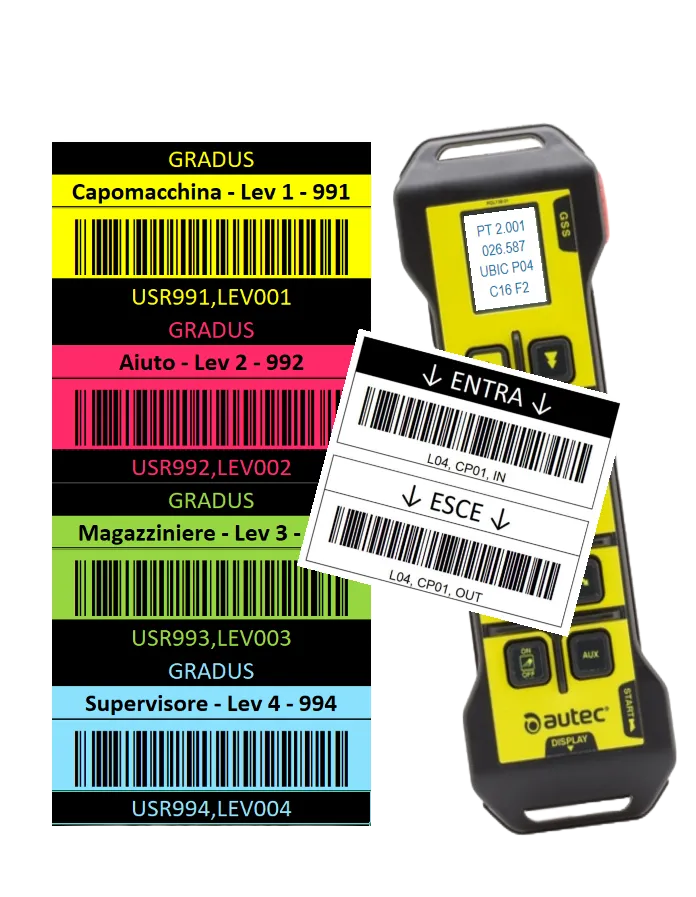
The operator logs in on the pendant with their barcode, and every movement carries their name.

The stacks

Nine checks on every coil, before setting it down.

The system looks at the shape of the stack and the forces at play, and warns the operator when a position should be avoided. In the 3D model the coil changes colour: orange if it breaks a stacking rule, red if it risks falling.

  • Nominal
  • Medium risk
  • High risk
  • Being placed

A stack is three courses high at most. Here the crane is lowering a coil into the gap in the third course — filling it is what makes the thrust from above symmetrical. The other two coils have already been classified by the force calculation.

  • Asymmetric thrust

    The coil is pushed more from one side than the other: the gaps need filling.

  • Larger diameter

    The coil is larger than the two supporting it.

  • Diameter difference

    The neighbouring coil’s diameter differs by more than 10%.

  • Wide gap

    A lot of space is left between the coil and its neighbour.

  • Excessive gap

    The space towards the neighbour exceeds the allowed limit.

  • Narrow base

    The coil is tall and narrow, with a diameter over 1.5 times its width: it can tip over.

  • Very narrow base

    The diameter is more than twice the width: the tipping risk is high.

  • Excessive pressure

    The coils above weigh too much on this one.

  • Interpenetration

    The coil wedges into its neighbours: that spot calls for a smaller diameter.

Access control

Everyone does only what their role allows.

Near the cranes there are one or more desks with a monitor and a barcode reader. The operator switches on the pendant, scans their own barcode, and from then on sees only the functions of their level. The pendant stays tied to that crane until they log off, so every scan lands on the right machine. Usually there is one operator per crane on a shift.

  1. Level 1

    Crane leader

    Drives the crane freely outside the warehouses. Inside, lowering is locked.

  2. Level 2

    Crane assistant

    Works only on scanned coils, and only in guided mode.

  3. Level 3

    Warehouse operator

    Works only on scanned coils, in manual mode too.

  4. Level 4

    Supervisor

    Can do everything. A level to give to few people.

Sheet of barcode labels, one per operator level, beside the industrial pendant with its in and out codes.

Pendant and barcodes

When a coil enters the warehouse, the operator first scans the “IN” code on the back of the pendant, then the lot barcode. When it leaves, they use the “OUT” code. Every entry and exit is recorded without typing anything.

On the left, the sheet of labels, one per level. On the right, the pendant with the reader and the in/out codes applied on the back.

The numbers

How the warehouse is doing, in a few numbers.

Gradus records every movement of every operator in detail, and sums it all up in a few daily, weekly or monthly indicators. Those numbers are enough for the production or plant manager to see how things are going, without opening any archive.

  • Recorded movement
  • Aggregated per period
  • Indicator
  • Reference line

On the left, every pick and every place, one lane per operator on shift. In the middle, the same movements aggregated per period. On the right, the indicator that comes out of them, read against its own reference line — that is what reaches the desk.

  • At a glance

    A few indicators, readable in a minute. The full movement log stays there, for anyone who wants to consult it.

  • Problems show up earlier

    When a number moves, the problem usually follows. You see the trend over time and understand whether the warehouse is getting better or worse.

  • Numbers to share

    Shown to the people who work in the warehouse, these indicators become a starting point for improving together. That is what they are for, not for handing out grades.

On the crane you have, or on a new machine.

Gradus was born for retrofit: the crane you have stays as it is. If a new machine is needed instead, with our partners we deliver it complete with coil tongs, guided or automatic. And the same logic can be taken outside the steel industry too.

  • Existing plant
  • Added by Gradus

In grey, the crane you already run. In blue, the only parts Gradus adds: position encoders, a scanner on the trolley, the cabinet and the shop-floor keypad.

Download the flyer (PDF, Italian)

What gets added

What gets bolted to the crane you have.

No structural work, no crane replacement. These are the parts that go on the machine so the system always knows where it is and what it is holding.

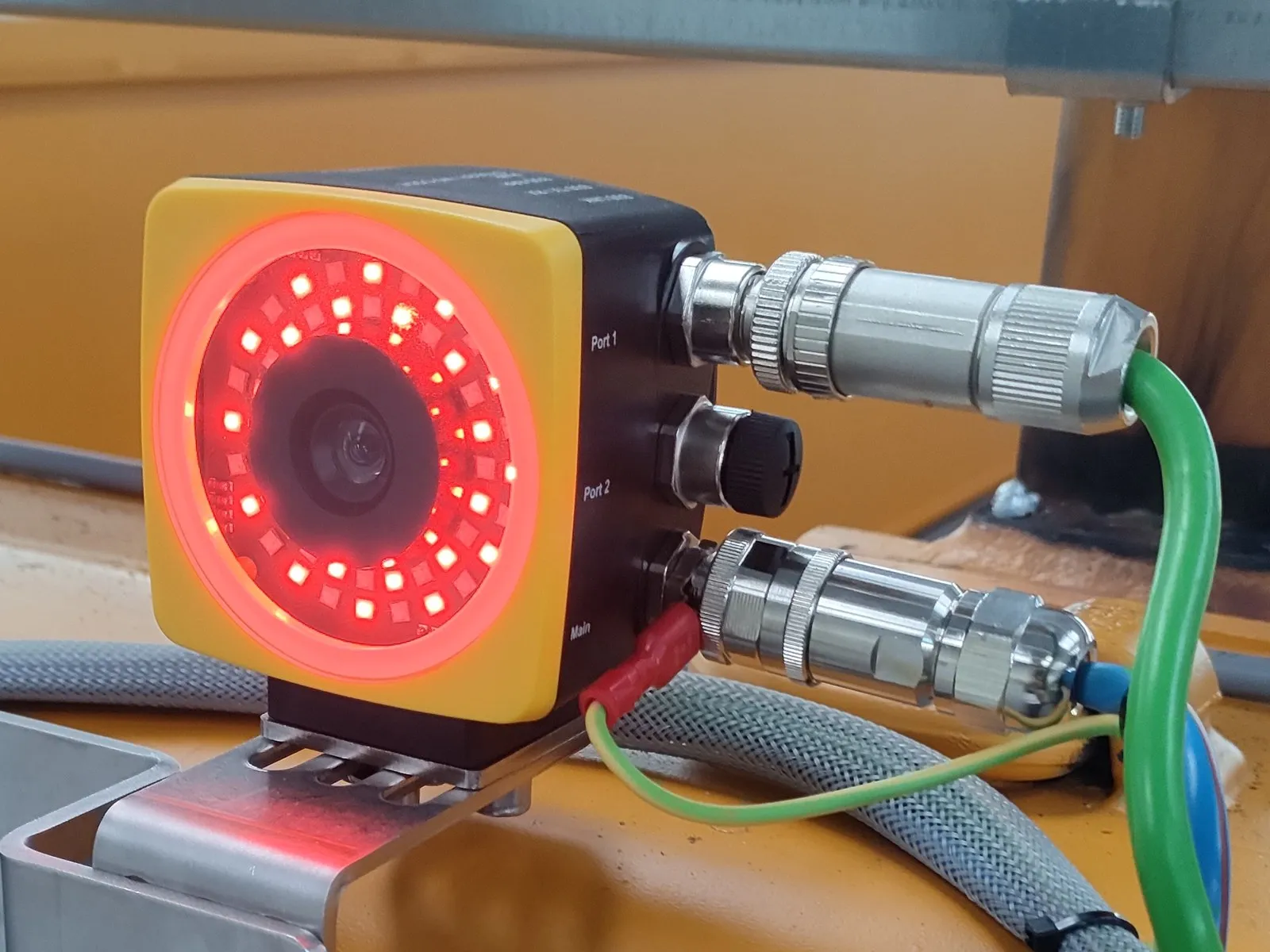
  • Industrial code reader with a red ring illuminator, fixed by a steel bracket to a crane girder.
    Code reader A code reader on the machine. The material identifies itself: nobody types it and nobody writes it down.
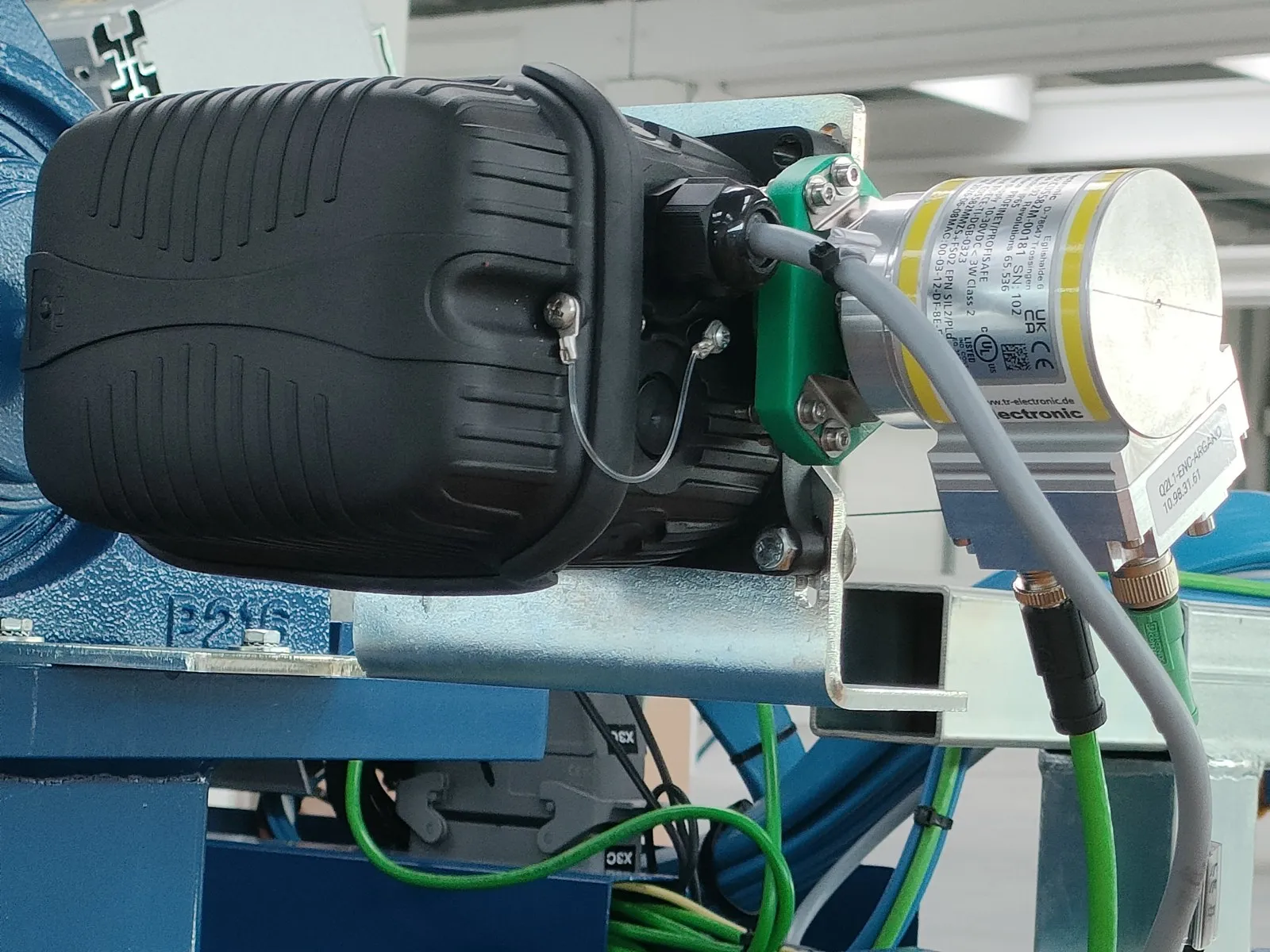
  • Absolute encoder coupled to a crane drive motor on a bracket, with industrial network cabling.
    Absolute encoder It measures to the millimetre and does not lose its reference when the machine is switched off. This is what lets a coil be placed without anyone watching from underneath.
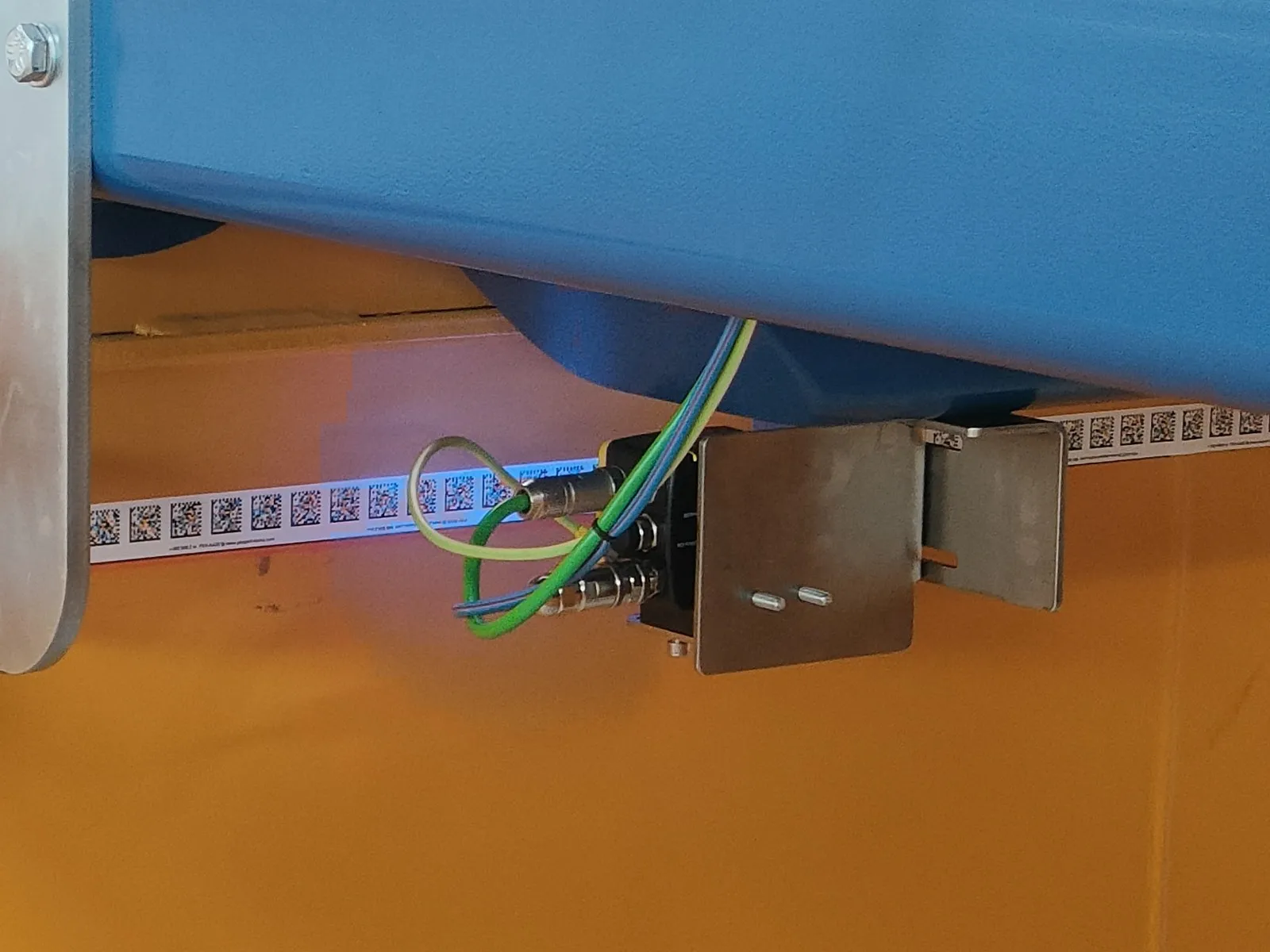
  • Datamatrix tape applied along the runway girder, with the reading head fixed to the trolley.
    Position tape It runs the length of the runway and tells the bridge where it is, absolutely, with nothing to re-zero and nothing to drift.

The videos

Gradus at work.

Two short videos. The first shows the everyday problems of a coil warehouse, the second follows a guided mission step by step.

The four problems of a coil warehouse
Gradus, step by step

The working environment

The screens the operator actually sees.

Three views of the system in service. Open the one you want — the animation is fetched only when you ask for it.

01 Guided mission

A multi-step guided mission: to free the requested coil, the system plans the moves for the coils blocking it.

02 Coil search

Coil search: from the lot code to the exact location, with the coil’s position, weight and measurements.

03 Force-vector analysis
Force analysis Example data
Q0 Q1 Q2 Q3 = 0
  • Coil under analysis
  • Reaction from neighbours
  • Contact missing

2000450112 SI_COIL_ZN_S · 1,250 mm · 12.5 t

Description Weight Q0Q1Q2Q3 Q2+Q3
Magnitude [t] 12.5 24.16.815.90.0 15.9
Angle [°] 62.4117.6-126.30.0 -126.3

Result High risk — asymmetric thrust

Force-vector analysis resolves the load onto each of the coil’s contacts. When a contact is missing, the resultant loads entirely onto the other.

Frequently asked questions

The questions we are asked most often.

Do we have to replace our cranes?

No. Gradus was born precisely to be fitted on the cranes you already have.

Does the operator lose control of the machine?

No. The system computes the mission, but it is the operator who starts it and keeps it going, with a button held down from a distance. Let go, and the crane stops. And when driving manually, Gradus does not plan the route but keeps recording every pick-up and every drop-off.

Does it integrate with our management system?

Yes, and it is precisely the link with the management system that makes coil search immediate: Gradus works on the same lots and the same locations you already use. For many management systems the connector already exists, because we built it for other customers; when it has to be written, it is a contained piece of work.

Does it only work in the steel industry?

It was born with steel coils, it already works with aluminium too, and the same logic applies to sheet packs. It can be adapted to other sectors with similar handling problems.

How complex can a mission be?

Very. To reach a coil at the bottom of a stack the system can plan the movement of several coils, up to six, in a single mission. For the operator it is always just one button.

What traceability do we get?

Every movement carries the name of the operator who commanded it, and for every coil the location, position, characteristics and full movement history are kept.

How much work does it ask of our team?

Little. Gradus is not a new management system to set up: it is a system of its own that leans on the one you already have. There is a standard configuration that works from day one, and from there it is tuned in steps, without stopping the warehouse for weeks.

What is it built on?

On computing tools made for large amounts of data. They are there to examine the whole bay, stack by stack, in the time between the operator’s request and the crane setting off. The answer comes before the crane moves.

How is it different from a WMS?

A generic WMS manages locations and stock. Gradus knows the diameters, widths, supports and forces of sheet coils, and that is why it can say where a coil sits safely, not just where there is room.

Origin

Where it was born, and why it has this name.

Gradus was born in the warehouse, over years spent talking to IT and to management, but above all to the operators, on morning, afternoon and night shifts. There are plenty of systems that manage a warehouse. Built specifically for sheet coils, very few.

“Gradus” means step. The name comes from Muzio Clementi’s Gradus ad Parnassum, the method with which nineteenth-century pianists moved up one exercise at a time. That is the idea we like: you improve one step at a time, and every step is already a result.

We will show it to you on your own warehouse.

Request a demo